
 C:\Content\Practical Guides\Corporate Photography That Makes a Business Look Credible
Corporate Photography That Makes a Business Look Credible
September 15, 2026
A business can be legitimate, experienced, and genuinely good at what it does—and still look untrustworthy online. The problem is often not the company. It is the photography representing it.
Customers make fast judgments from a website, Google Business Profile, proposal, LinkedIn page, and social feed. Before they read the service description, they notice whether the people look approachable, whether the workplace looks real, whether the images feel current, and whether everything appears to belong to the same organization. Corporate photography is not decoration. It is visual evidence.
For a Jacksonville business, credibility photography should answer several questions almost immediately: Who are these people? Where do they work? What does the experience feel like? Can I trust them with my money, time, property, health, or reputation? The strongest photo library answers those questions without forcing the viewer to work for it.
What “credible” actually looks like
Credibility does not require stiff poses, an expensive downtown office, or a wall full of awards. It comes from consistency, specificity, and context. A credible image feels intentional but believable. The lighting is controlled. The setting is clean without looking artificial. The subject looks like a real professional rather than a person trapped in a stock-photo handshake.
That distinction matters because generic imagery cannot prove anything about your business. A stock photo may illustrate “customer service,” but it cannot show your staff, your process, your equipment, or the environment a customer will actually encounter. Original photography gives a visitor information that competitors using interchangeable imagery cannot provide.

The five images every business should have
1. A strong leadership portrait
The primary portrait should work on the company website, LinkedIn, press releases, speaking profiles, proposals, and publications. It needs enough negative space to support different crops. It should feel polished, but it should still resemble the person clients will meet.
2. Consistent team headshots
Team pages lose credibility when one portrait came from a wedding, another was photographed against an office wall, and a third is a phone selfie. The individual images do not have to be identical, but they should share lighting, framing, color, and background logic.
3. Environmental portraits
An environmental portrait places a person inside the context of their work: an attorney in a conference room, a contractor at a project site, a clinician in a treatment space, or a producer in a studio. It communicates both personality and competence.
4. Process and detail photographs
Customers want to understand what happens after they say yes. Photograph the tools, hands, screens, materials, preparation, and quality-control steps that make the service real. These images are especially useful for service pages, case studies, recruiting, and social media.
5. A genuine client experience
When privacy and permissions allow it, show the interaction between the business and the people it serves. The objective is not to stage a theatrical smile. It is to capture attentiveness, communication, and the small signals that tell a customer how they will be treated.
Start with usage, not a camera
A productive shoot begins with a distribution plan. Before creating a shot list, identify where the images will appear and what each placement requires. A horizontal website hero needs different composition from a vertical Reel cover. A Google Business Profile image needs to remain clear at a small size. A press portrait should leave room for an editor to crop.
| Use | Best orientation | What the image must communicate |
|---|---|---|
| Website hero | Wide horizontal | Brand, environment, and immediate trust |
| About/team page | Vertical or square | Approachability and consistency |
| Service page | Mixed | Process, expertise, and real conditions |
| Google Business Profile | Horizontal and square | Location, staff, exterior, and customer experience |
| LinkedIn/press | Vertical with crop room | Professional identity |
| Social media | Vertical-first | Fast context and visual variety |
Google’s own Business Profile guidance recommends category-specific photos such as exterior, interior, product, work-at-business, food and drink, common areas, rooms, and team photos where those categories apply. The practical lesson is simple: do not upload twenty versions of the same portrait. Build a library that documents the whole customer experience. Google Business Profile photo guidance.
Build a shot list around business questions
A shot list is most useful when it is tied to what customers need to know. “Photograph the office” is vague. “Create a wide exterior image that helps a first-time visitor recognize the entrance” is useful. “Get team photos” is vague. “Create matching headshots plus candid collaboration images for the About and Careers pages” gives the photographer a real goal.
I normally organize the list into people, place, process, proof, and personality. People includes leadership and team portraits. Place includes the exterior, entrance, work areas, customer areas, and recognizable Jacksonville context when relevant. Process documents how the work happens. Proof shows finished products, equipment, certifications, or visible outcomes. Personality captures the human details that make the company memorable.
Prepare the location before the shoot
A camera notices everything. Exit signs, extension cords, half-empty water bottles, fingerprints, crooked blinds, cluttered desks, and temporary signs become permanent parts of the image. Cleaning the frame does not mean making the business look fake. It means removing distractions that compete with the subject.
Walk every planned angle before the photographer arrives. Decide what stays and what moves. Check branded clothing, uniforms, name badges, safety equipment, monitors, confidential paperwork, and anything that could create a privacy problem. If customers or employees will appear, secure appropriate permission in advance.
Wardrobe should support the brand
The safest wardrobe is usually simple, well-fitted, and consistent with how the person actually works. Avoid tiny repeating patterns that can create visual interference on camera. Coordinate colors without making everyone wear the same outfit. If the company has uniforms, photograph them in excellent condition. Bring backups because lint, sweat, wrinkles, and spills are easier to prevent than repair.
Most importantly, do not costume people as a fantasy version of the business. A creative agency does not need to dress like a bank. A contractor should not look uncomfortable in a suit. Credibility comes from alignment between the image and the real customer experience.
Lighting separates “professional” from “expensive camera”
Modern phones and cameras can create technically sharp images, but sharpness alone does not create authority. Directional light shapes a face, separates the subject from the background, controls color, and guides attention. Mixed fluorescent, daylight, and warm practical lighting can make skin tones inconsistent from room to room. A professional approach controls or balances those sources so the full library feels cohesive.
That consistency becomes more valuable over time. When a business can pull from a unified library for a proposal, recruitment post, service page, and news release, every touchpoint reinforces the same identity.
Do not confuse authenticity with carelessness
“Authentic” is sometimes used as an excuse for weak execution. A crooked phone photo is authentic in the sense that it happened, but it may not communicate the care a business brings to its work. The goal is directed authenticity: real people, real environments, real work, and real expressions presented with professional attention.
Good direction also helps people who dislike being photographed. Instead of demanding a smile, give the subject something to do. Ask a real question. Let them demonstrate a process. Photograph the moment between poses. Those small adjustments produce expressions that look human rather than forced.
Create a library, not a handful of hero images
A commercial shoot becomes more valuable when it produces variations. Capture wide, medium, and detail views. Photograph horizontal and vertical compositions. Leave clean space on both sides for text. Create versions with and without direct eye contact. Record a few short motion clips during the same setup when appropriate.
This is where photography connects naturally to video production, search strategy, and ongoing content. One planned production day can support months of pages, posts, proposals, and campaigns when every asset has a defined purpose.
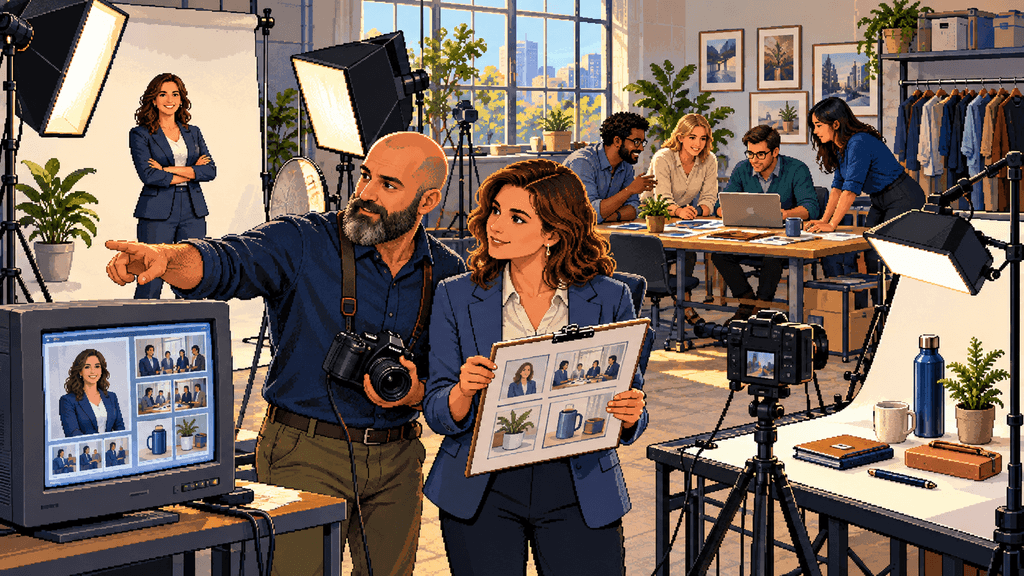
A practical pre-shoot checklist
- List every website page and campaign that needs imagery.
- Choose horizontal, vertical, and square requirements before shooting.
- Build a people/place/process/proof/personality shot list.
- Confirm access, parking, load-in, power, and scheduling.
- Prepare the location and remove confidential material.
- Coordinate wardrobe and bring backups.
- Collect permissions for employees, customers, and locations.
- Reserve enough time for lighting changes and natural moments.
- Plan file naming, storage, backups, and licensing.
- Identify who will approve final selections.
How to evaluate the finished photographs
Do not judge only by whether everyone likes how they look. Ask whether the library can do the job. Does it show the business accurately? Are there enough formats for the website and social platforms? Does the color remain consistent? Can the customer understand the environment and process? Do the images feel specific to this organization?
Credible corporate photography reduces uncertainty. It gives a prospect evidence that the business exists, the people are real, the operation is organized, and the experience has been considered. That is a much more valuable outcome than simply having “nice pictures.”
Planning corporate photography in Jacksonville
Jacksonville businesses have access to an unusually broad range of environments: downtown offices, industrial facilities, medical campuses, beaches, neighborhoods, warehouses, restaurants, studios, and outdoor locations. The right setting is not automatically the prettiest setting. It is the one that supports the story the customer needs to understand.
If your current website relies on mismatched headshots, old phone images, or generic stock photography, I can help you plan a practical commercial photo library around the pages and campaigns you actually need. Explore my photography work, then get in touch to build a shoot that makes your business look as credible as the work behind it.
A business can be legitimate, experienced, and genuinely good at what it does—and still look untrustworthy online. The problem is often not the company. It is the photography representing it. Customers make fast judgments from a website, Google Business Profile, proposal, LinkedIn page, and social feed. Before they read the service description, they notice whether the people look approachable, whether the workplace looks real, whether the images feel current, and whether everything appears to belong to the same organization. Corporate photography is not decoration. It is visual evidence. For a Jacksonville business, credibility photography should answer several questions almost immediately: ...
Start a new thread