
 C:\Content\Practical Guides\Local SEO for Jacksonville Businesses: A Practical Guide
Local SEO for Jacksonville Businesses: A Practical Guide
September 8, 2026
Local SEO for Jacksonville businesses starts with a straightforward goal: help nearby customers find you, understand what you offer, and feel confident enough to contact you. That takes more than putting a city name in a headline. Your Google Business Profile, website, reviews, and actual customer experience need to tell a consistent story.
Local search is often presented as a bag of tricks: add keywords, collect reviews, and wait for the phone to ring. A Jacksonville business is actually competing to become the most credible answer for someone with a specific problem, limited time, and several alternatives on the same screen. Visibility matters, but the ability to turn that visibility into qualified business matters just as much.
This practical guide connects the work that helps: accurate business information, useful service pages, original media, honest reviews, local relationships, and measurement. It also includes a 90-day plan you can use to prioritize improvements.
How Local SEO Works
Local search has two connected surfaces: map results built around Google Business Profiles and conventional organic results built around web pages. A company can appear in one, both, or neither. Treat the profile and website as parts of the same business identity.
Google describes its main local ranking factors as relevance, distance, and prominence. Relevance means how closely a business matches a search. Distance concerns how far it is from the location associated with the search. Prominence concerns how well known the business is, with signals including reviews and links.
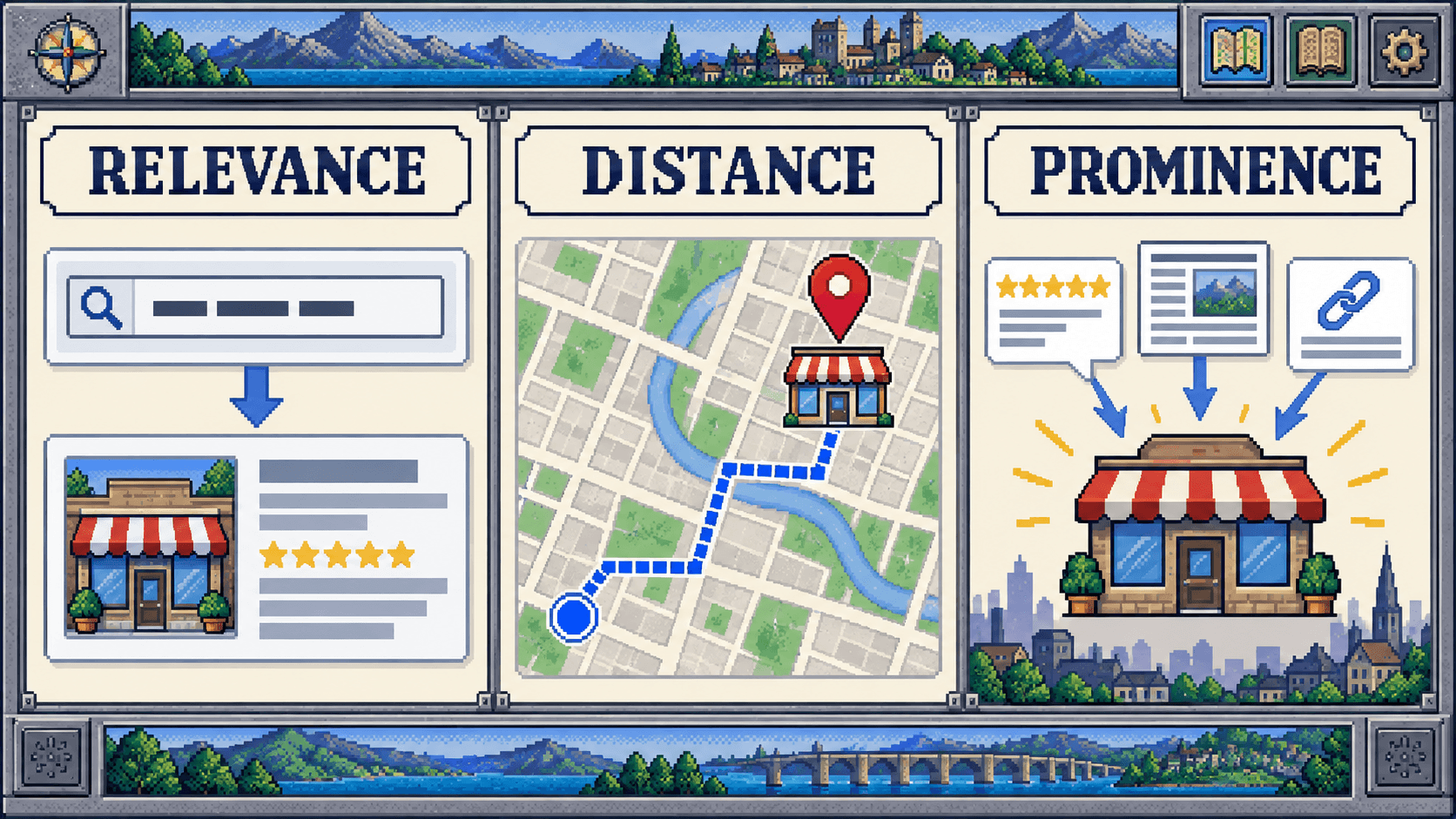
This framework separates what you can improve from what you cannot control. You cannot move every prospective customer closer to your office. You can make your services easier to understand, correct the information Google has, earn reviews and relevant mentions, and improve the experience after someone clicks through. No agency can buy a better organic local ranking directly from Google.
Start With Customer Intent
Before editing title tags, identify the situations that cause customers to search. A homeowner with an urgent leak searches differently from a facilities manager planning maintenance. Someone looking for lunch near Riverside has a different decision window from a company comparing production crews across Northeast Florida.
For each important service, write down who buys it, what problem starts the search, where you can realistically deliver it, and what the next action should be. This is more useful than a spreadsheet containing hundreds of loosely related phrases. Separate urgent searches, comparisons, pricing questions, and requests for a specific service.
Imagine a small production business receiving inquiries for events, interviews, and social content. A single sentence saying “we do video” leaves each customer guessing. Separate, substantial service explanations can address the different planning questions. The event client needs coverage details; the interview client needs to understand sound, lighting, and scheduling. These are examples of intent, not a reason to create a new page for every keyword variation.
Use Jacksonville locations accurately
Jacksonville, the Beaches, and surrounding communities are not interchangeable service promises. Describe your actual coverage, travel arrangements, appointment requirements, and limitations. A customer should not discover a location surcharge only after contacting you.
Do not manufacture dozens of pages that simply swap Riverside, Mandarin, San Marco, or another place name. A location page deserves to exist when it contains distinct information: an actual office, local projects, availability, directions, delivery constraints, or useful questions. Repeated copy with different city names adds little value.
Complete Your Google Business Profile
Your profile may be the first full impression a customer receives. The category, hours, number, services, photographs, and reviews can influence a decision before a website visit. Start by verifying ownership and checking every important field.
Choose a specific primary category that accurately describes your main business. Add appropriate secondary categories for real activities. Use your actual business name rather than adding promotional keywords. Keep your phone number, website, regular hours, and special hours current. Google recommends complete and accurate information as part of improving local visibility.
If customers visit a staffed location during stated hours, represent that location accurately. If you travel to customers and do not receive them at your address, follow Google’s service-area business rules. Do not present a virtual office or private residence as a storefront merely to target an area. Consult Google’s business representation guidelines when your situation is unclear.
Link the profile to the most helpful relevant page. A business with one location may use a clear homepage. A company with multiple real offices may have a dedicated page for each location. The destination should confirm the same service, identity, and contact details the searcher just saw.
Set aside time each month to check suggested edits, hours, services, duplicate profiles, and new reviews. Business information can drift quietly. A simple ownership record also helps: know which company-controlled account manages the profile and who has access, so a departing employee does not take the business’s visibility with them.
Make Your Website Help Customers Decide
The landing page should answer five questions quickly: Am I in the right place? Do you provide what I need? Do you serve my area? Can I trust you? What happens next? Search optimization cannot compensate for a confusing offer.
Use the service and location naturally in the page title, main heading, and introductory copy when they describe the page. Explain scope, deliverables, timelines, and common constraints. A page about a service should describe that service, not repeat “Jacksonville” until the copy becomes difficult to read.
Make contact actions obvious on a phone. Test the phone link, contact form, appointment tool, and confirmation message. Submit a real test inquiry and verify that it arrives. A form that appears to work while sending nothing can quietly waste every channel bringing people to the site.
A contact page should contain the information customers actually need. For a public location, include accurate hours, address, directions, parking, and relevant accessibility information. For a service-area business, explain coverage and appointments without exposing a private address unnecessarily.
Build substantial service pages
A useful service page explains who the service is for, what is included, what affects cost, what the process looks like, and what information you need from a customer. Show examples and answer objections. You do not need to publish a fixed price when every project is different, but you can explain the variables that determine a quote.
For example, a video project may involve planning, crew, sound, lighting, editing, revisions, and delivery formats. Explaining those choices makes an inquiry more productive. My video production services page illustrates the kind of decision support a service business can provide.
Use descriptive internal links between related guides and services. A customer reading about preparing for a shoot should be able to reach the production service page. Avoid placing every possible link in every paragraph; each link should have a clear reason to be there.
Fix Technical Problems Before Producing More Pages
Check whether important pages can be indexed, whether they load properly on mobile, and whether navigation exposes them. Google Search Console helps identify indexing issues and the queries bringing impressions. A page blocked from indexing or buried behind broken navigation needs attention before another article does.
Prioritize practical speed improvements: appropriately sized images, responsive image variants, caching, and fewer unnecessary scripts. Test changes on forms and booking tools. The fastest page is not useful if an aggressive optimization setting breaks the action customers came to complete.
LocalBusiness structured data can describe supported details such as address and opening hours. Keep markup consistent with visible content, and validate it. Structured data helps describe a business; it does not guarantee enhanced results or a particular ranking.

Build an Honest Review Process
Google says review count and positive ratings can help local ranking. Reviews also help customers assess communication, reliability, and how a company handles problems. Their value goes beyond the star displayed beside your name.
Ask real customers for honest reviews after delivering value. Make the request easy to follow and apply the process consistently. Do not buy reviews, invent customers, offer incentives for Google reviews, or selectively solicit only positive feedback. Google’s Maps contribution policy explains prohibited engagement.
Reply professionally. A response to criticism is also being read by future customers. Acknowledge the concern and offer an appropriate way to resolve it without revealing private information. Repeating keywords in every reply makes the interaction feel automated and misses its purpose.
Read reviews as research. Repeated praise identifies what customers value. Repeated confusion suggests missing information on the site. Repeated complaints may indicate an operational issue. Fixing that issue can matter more than another round of optimization.
Earn Local Links and Mentions
Local prominence grows through real relationships and useful contributions. Relevant mentions may come from professional associations, community organizations, suppliers, event partners, local publications, or businesses you work with. A link is most defensible when there is a clear reason for that organization to reference you.
Start with what you can contribute: an expert interview, helpful checklist, documented project, community event, or resource people can use. Do not treat every relationship as a transaction for a backlink. A small number of relevant references can support the business in ways a mass directory package cannot.
Maintain accurate information in directories that customers use. Correct outdated names, addresses, and numbers, and address duplicates where possible. Treat this as identity maintenance, not an endless submission campaign. Keep a record of listings you control so future changes are manageable.
Use Original Photography and Video
Photos of your team, workspace, products, equipment, and completed work help customers understand who they are considering. Short videos can introduce the business, explain a process, answer a common question, or show the result of a project. Google recommends adding photos and videos to Business Profiles.
Choose material that answers a question. A customer may need to see the entrance, the scale of a project, or the person they will meet. Authentic, relevant images often provide more useful evidence than an attractive stock photograph with no connection to the company.
Use descriptive filenames, appropriate compression, and meaningful alt text. Alt text should describe the image for someone who cannot see it, rather than serve as a list of target keywords. Get permission before showing identifiable customers or confidential work.
This is where video production and photography support local marketing. A planned shoot can supply website images, profile photos, service explanations, and social material. Plan those uses before production so the files fit the places they will appear.
Publish Answers Your Customers Need
Use sales calls, emails, reviews, and Search Console to identify recurring questions. Pricing, preparation, scheduling, comparisons, and service limitations are often useful starting points. Write the answer your customer would need before making a decision.
Local content needs local substance. A production company might explain weather contingencies or travel planning. Another business might discuss delivery coverage or appointment logistics. Verify any claims about rules or permits with the relevant authority, rather than adding unsupported local detail to make a page sound specific.
A sustainable plan could involve one strong guide, an updated project example, and improvements to existing service pages each month. It should fit the business’s capacity. An updated page already receiving relevant impressions may be a better investment than publishing a new URL on a schedule.
Measure Qualified Leads
A ranking is a diagnostic signal, not a sale. Local results vary with the searcher’s location and query, so a position checked from one computer cannot describe the entire market. Connect visibility to actions and business outcomes.
- Use Business Profile performance to review available interactions.
- Use Search Console to examine queries, impressions, clicks, and landing pages.
- Track forms, appointments, and other meaningful actions in analytics.
- Record lead quality, booked work, and revenue in your business process.
- Track major site changes so performance shifts have context.
Keep reporting understandable. Ten qualified inquiries can be more useful than hundreds of visits from people seeking a service you do not sell. When traffic rises but inquiries do not, review intent and the page experience. When inquiries arrive but rarely close, review fit, follow-up, scope, and pricing before assuming visibility is the only problem.
Your 90-Day Local SEO Plan
Days 1–30: Accuracy and a Baseline
Confirm profile ownership, correct business details, and test your contact paths. Connect or review Search Console and analytics. List your main services and their corresponding pages. Document the current baseline: relevant searches, landing pages, inquiries, and obvious technical problems.
Prioritize failures that block customers first. A wrong number, unavailable page, or missing inquiry email is more urgent than a minor wording improvement. Assign an owner to each issue and record what was changed.
Days 31–60: Relevance and Trust
Improve your most important service page and contact page. Add original examples, useful FAQs, and clear next steps. Correct major directory inconsistencies. Establish a consistent review request process. Improve oversized images and mobile usability, then retest conversions.
Focus on one service well before expanding across many pages. A complete example gives you a useful model for the rest of the site and makes it easier to judge what information is missing.
Days 61–90: Content and Relationships
Publish a useful customer guide or project example. Pursue relevant local relationships and update profile photos. Review which queries and pages generate useful inquiries. Set a monthly maintenance routine and adjust priorities based on results.
Ninety days is a planning window, not a promise of a particular position. Competitive visibility can take longer, and results depend on the starting point, market, and quality of execution.
Common Mistakes to Avoid
Thin location pages: Swapping place names without distinct information creates weak pages. Inaccurate profiles: Keyword-heavy names or false locations can create policy and customer problems. Broken conversion paths: More visibility cannot fix a form that fails.
Generic content at scale: AI can assist production, but pages still need accurate information and human judgment. Ranking guarantees: No consultant controls every factor in local results. Artificial reviews and links: Shortcuts can undermine the trust the business is trying to earn.
Frequently Asked Questions
How long does local SEO take?
There is no universal timetable. Correcting information can help quickly, while stronger content, reputation, and competitive visibility develop over time. Evaluate progress against a baseline and business outcomes.
Do I need a page for every Jacksonville neighborhood?
No. Create a separate page when you can provide distinct, useful information. A page that only substitutes one neighborhood name for another is unlikely to help customers.
Can a service-area business keep its home address private?
Eligible businesses that travel to customers can follow Google’s service-area rules and hide an address where customers are not received. Represent the business accurately and check Google’s current guidance.
Is a Business Profile enough?
A profile can generate visibility, while a website provides space for detailed services, proof, and conversion paths. They work well together because customers often need more information before contacting a company.
Should I pay for local SEO?
That depends on your time, experience, and the work required. Ask for clear deliverables, ownership of accounts, meaningful reporting, and an explanation of priorities. Be cautious of guaranteed rankings and vague packages.
Build a Business People Can Find and Trust
Local SEO works best when your information is accurate, your services are clear, and your evidence is credible. Make the profile useful. Show real work. Answer questions. Earn honest reviews. Then measure whether the resulting visibility brings the right customers.
If you need help prioritizing those improvements, explore my SEO experience and consulting services. A practical review can connect your search visibility, website content, and supporting media to a clearer plan for earning qualified inquiries.
References: Google: Improving local ranking; Business representation guidelines; LocalBusiness structured data; Maps contribution policy.
Local SEO for Jacksonville businesses starts with a straightforward goal: help nearby customers find you, understand what you offer, and feel confident enough to contact you. That takes more than putting a city name in a headline. Your Google Business Profile, website, reviews, and actual customer experience need to tell a consistent story. Local search is often presented as a bag of tricks: add keywords, collect reviews, and wait for the phone to ring. A Jacksonville business is actually competing to become the most credible answer for someone with a specific problem, limited time, and several alternatives on the same screen. Visibility matters, but the ability to turn that visibility into ...
Start a new thread