
 C:\Content\Personal Essays\Going Back to College in Your 40s for Healthcare
Going Back to College in Your 40s for Healthcare
October 8, 2026
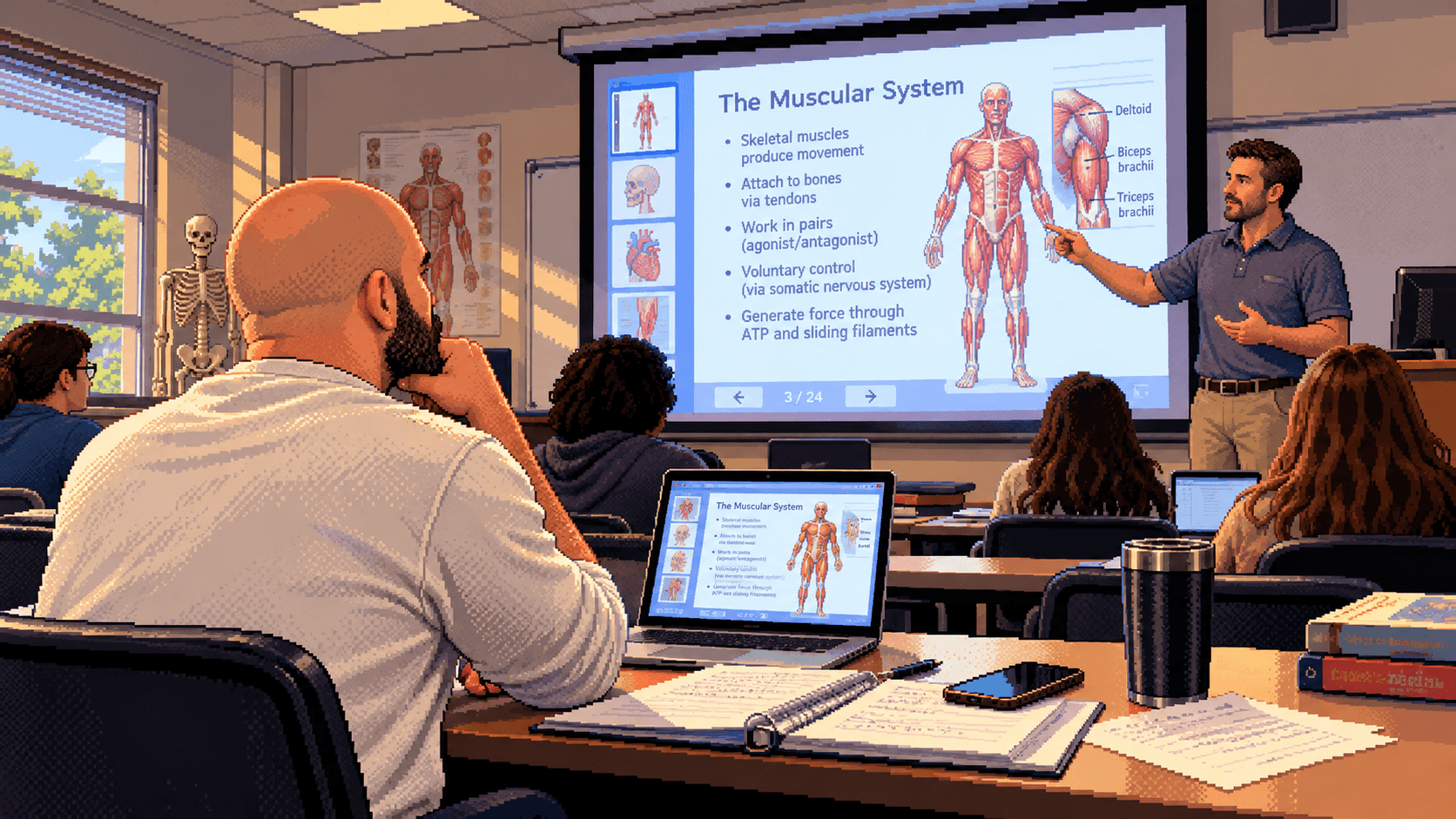
Last night, I sat in an Anatomy and Physiology classroom with a small laptop, my phone, an open three-ring binder, and more handwritten notes than I have taken in years. A PowerPoint presentation about the muscular system filled the screen while a human skeleton stood nearby, quietly reminding me just how much I am now expected to learn about the structures, relationships, and processes holding a person together.
This morning, the notes are still spread across my desk, and I am trying to absorb the reality of where my life has taken me. I am almost 44 years old, nearly twenty years removed from my last college class, and pursuing an entirely new career in healthcare.
Going back to college in your 40s sounds inspiring when condensed into a social-media post. In reality, it means inserting lectures, exams, assignments, and study sessions into a life that was already full. I am not returning as a young adult with an open schedule and an undefined future. I am returning as a father, an experienced professional, a small-business owner, and someone whose established career stopped delivering the stability I believed experience was supposed to earn.
I am currently attending Florida State College at Jacksonville and completing prerequisites for its Radiologic Technology program. This semester, I am taking four classes full time: Humanities, with an emphasis on the American Dream; Medical Terminology; United States History; and Human Anatomy and Physiology. At the same time, I am co-parenting, completing client work, developing business projects, and trying to determine what the next twenty years of my working life should look like.
The Layoff That Forced the Question
I returned to school because I was laid off from Superior Fireworks.
I worked there from the beginning of 2024 into the middle of 2025, managing marketing and video production across multiple areas. I was working hard, and the work felt like it mattered, but much of the marketing technology and methodology available to me felt closer to what the industry had been doing around 2016 to 2018. The operation did not meaningfully incorporate artificial intelligence into its marketing workflow (even though I tried), and the speed of change outside the company was becoming impossible to ignore. Tarriffs ended up being the real reason provided for my layoff, but I still question that sometimes.
While I was working inside one system, the broader profession was rapidly becoming another.
Generative AI was changing content production, research, search, automation, analytics, creative development, and the expectations placed on marketers. Tasks that once demonstrated specialized value could suddenly be completed faster, more cheaply, and at enormous scale. By the time I was laid off, I felt as if the industry had accelerated while I had been working inside a time capsule.
That does not mean I knew nothing about AI. I had been discussing the arrival of AI and its potential for years before it landed. I even worked on a project as far back as 2019 around an “AI news website” that would provide AI generated news articles. I understood what was coming conceptually. But knowing that a change is coming is different from working inside that change every day. Tools, platforms, workflows, and expectations were developing faster than almost any individual could comfortably absorb.
I had more than a decade of digital-marketing experience and more than twenty years of content-production experience, yet I emerged from the layoff feeling simultaneously overqualified for some positions and behind the curve for others. My experience had not disappeared, but the market had begun assigning different value to parts of it.
That was the moment when returning to school stopped feeling like an abstract possibility. It became a practical response to a professional reality I could no longer ignore.
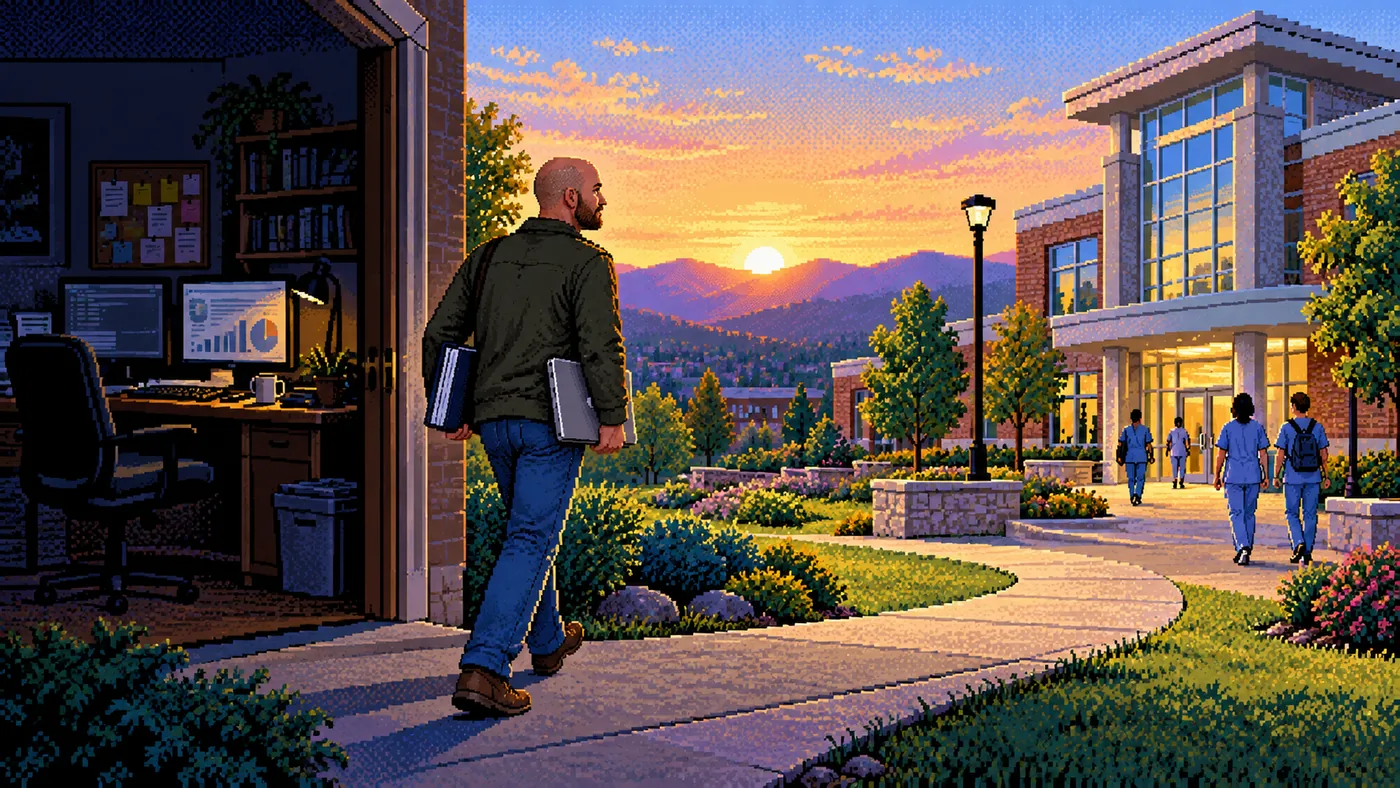
Twenty Years Is Longer Than It Sounds
College did not simply wait where I left it.
The technology is different. The expectations are different. The volume of information is different. Assignments live inside online systems surrounded by digital textbooks, quizzes, discussion boards, calendars, notifications, modules, and deadlines. I carry more computing power in my phone than an entire classroom probably had during my earlier college experience, yet none of that has made the workload feel simple.
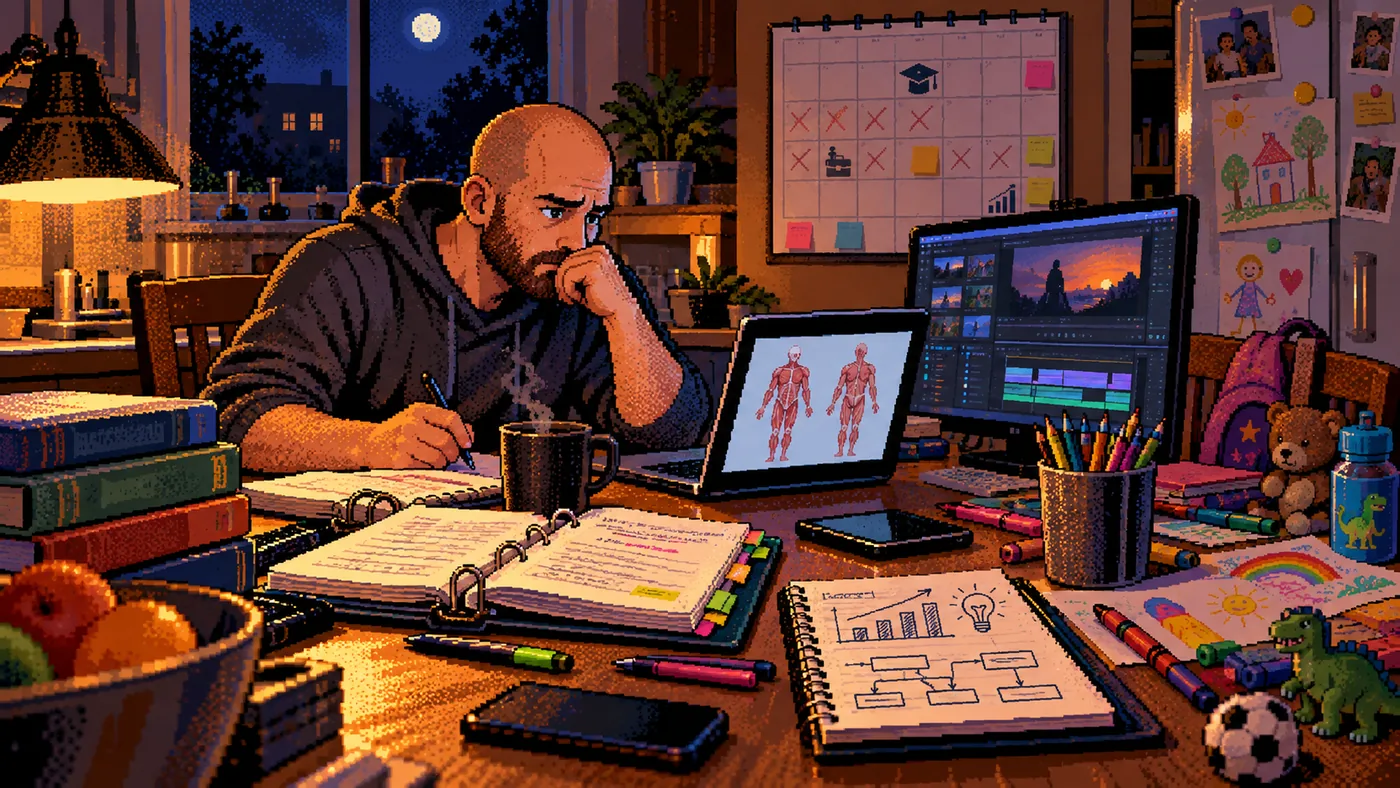
There is always another tab open. One contains Anatomy and Physiology. Another contains Medical Terminology. Another has an assignment about the American Dream. Another contains client work, a video export, a website, an invoice, or a business plan. Somewhere behind all of them is a calendar reminding me that midterms are approaching whether I feel ready or not.
When I was younger, school was something I attempted to fit around the beginning of adult life. Now, school has to fit inside a life that is already completely assembled. That life includes children who need me, clients with deadlines, financial responsibilities that cannot be postponed, and a body that no longer accepts unlimited stress without sending an invoice of its own.
School did not enter an empty schedule. It displaced something every time I made room for it.
Four Classes Require Four Different Versions of My Brain
Each class asks me to think differently.
Humanities asks me to examine the American Dream: what it promises, whom it serves, how it is represented, and whether the promise still matches reality. That subject feels unusually personal now. I am pursuing a new professional direction partly because the version of the American Dream I followed did not deliver the security it advertised.
I developed valuable skills. I accumulated experience. I learned new technology whenever I could. I worked for corporations, small businesses, and television stations. I created videos, websites, podcasts, campaigns, brands, and independent projects. I did the work people are told will eventually create stability.
Then I was laid off and found myself competing in a labor market where companies could automate parts of the work, outsource other parts internationally, or hire someone much younger whose experience was built entirely inside the newest generation of tools.
History asks me to understand context and consequence. Medical Terminology asks me to learn a new language. Anatomy and Physiology demands precision. It is not enough to vaguely understand that one part of the body does something. I have to know the structure, its location, its relationship to other structures, and the process it supports.
My professional experience trained me to see systems, and that helps. A body is a system. A production workflow is a system. A marketing campaign is a system. A business is a system. But the human body is considerably less forgiving than a website. If I misspell something in a draft, I can correct it. If I make a mistake while building a webpage, I can troubleshoot it. Anatomy requires me to slow down, pay attention, and admit exactly how much I do not know.
That humility may be one of the most valuable parts of returning to school.
I Am Using the Skills From My Old Career to Build the New One
I have always understood information better when I can turn it into something tangible. Throughout my career, I learned by writing, designing, editing, producing, testing, explaining, and building. I have brought the same instinct into college.
When a concept feels abstract, I look for a way to make it visual. When terminology becomes overwhelming, I organize it into systems. I use technology and creative projects to help me study, connect ideas, and remember difficult material. Some of the projects I have built for these courses are not merely assignments; they are learning tools created through the same process I have used to solve professional problems for clients and employers.
The small laptop on my desk is not only there for schoolwork. It is the same kind of machine I use for client projects, research, editing, design, and business development. My phone is both a distraction and a portable reference library. My binder is filled with handwritten notes—the kind I had almost forgotten how to take.
Returning to school has brought the oldest and newest versions of how I work together. There is paper beside a laptop, a pen beside a phone, and twenty-year-old academic habits beside modern creative tools.
I am not starting over with nothing. I am carrying everything I have learned into a new field.
Why Radiologic Technology?
I am not pursuing radiologic technology because I believe healthcare will somehow remain untouched by artificial intelligence. That would be unrealistic. Radiology is already one of the medical fields most affected by AI, and those systems will continue changing how images are captured, processed, prioritized, interpreted, and managed.
What interests me is the difference between using AI to transform a job and using AI to eliminate the human being who performs it.
Radiologic technologists do not simply press a button and allow a machine to handle the rest. They position patients, operate sophisticated imaging equipment, follow radiation-safety procedures, evaluate image quality, communicate with people who may be injured or frightened, adapt examinations to physical limitations, and work directly with nurses, physicians, radiologists, and other healthcare professionals.
Those responsibilities exist in the physical world. They require judgment, presence, communication, safety awareness, technical competence, and human trust.
The U.S. Bureau of Labor Statistics projects employment for radiologic and MRI technologists to grow five percent from 2025 through 2035, faster than the average for all occupations. The agency projects approximately 15,300 openings per year over that decade, including positions created as workers retire, leave the profession, or transfer to other occupations.
That is not a twenty-year guarantee, and no honest source can promise that any occupation is completely protected from economic disruption. But it does suggest continuing demand for trained imaging professionals.
The more important distinction is how leading radiology organizations describe AI. The American College of Radiology has documented ways AI could automate parts of a CT workflow while allowing technologists to concentrate on higher-level steps involving patient safety and error prevention. The American Society of Radiologic Technologists has likewise studied AI as an evolving component of medical imaging rather than treating it as a simple replacement for technologists.
That is the kind of relationship with technology I want.
I am not looking for a career where AI never appears. I am looking for one where AI remains a tool inside work that still requires a capable person in the room.
Stability Does Not Mean Standing Still
There is a temptation to imagine healthcare as the safe choice and marketing as the risky one. The reality is more complicated. Healthcare changes. Imaging technology changes. Regulations change. Patient expectations change. AI will change the field significantly during the next twenty years.
Becoming a radiologic technologist will not allow me to stop learning.
If anything, my experience in marketing has taught me that the most dangerous thing a professional can do is assume that the tools and knowledge surrounding a job will remain frozen. I felt the consequences of spending too much time inside an outdated marketing environment while the wider profession moved rapidly toward AI-assisted work.
I do not want to repeat that experience.
If I enter medical imaging, I want to remain curious about the equipment, software, clinical standards, safety practices, and artificial-intelligence systems entering the profession. I want to understand what the tools do, where they fail, and how they can improve patient care without weakening human judgment.
The stability I am seeking is not immunity from change. It is a more durable relationship between my labor and the people who depend on it.
Midterms Make the Decision Feel Real
I am approaching the middle of the semester now, which means the novelty has worn off. The first-week energy has been replaced by the reality of maintaining the workload.
This is the point when returning to school stops being an announcement and becomes a test of endurance. Fresh starts look clean from a distance. Up close, they are built from deadlines, exhaustion, confusion, and repeated decisions to continue.
Four courses would be a significant workload without anything else competing for my attention. I am balancing them with parenting, client projects, financial pressure, and the businesses I am still trying to develop. There is no perfect balance. There are only priorities that shift depending on which deadline is closest and which part of life needs me most urgently.
An hour spent studying is an hour that does not go toward client work. An evening spent finishing an assignment may be an evening when I am less available as a parent. A Saturday morning devoted to anatomical terminology is time I am not spending exercising, building my businesses, editing, cleaning, or recovering.
At this age, the hardest part of college is not convincing myself that I can learn. It is accepting that every hour already had a purpose before I enrolled.
My Health Has Paid Part of the Price
The clearest evidence that this semester has changed my life is not in my grades. It is in my movement.
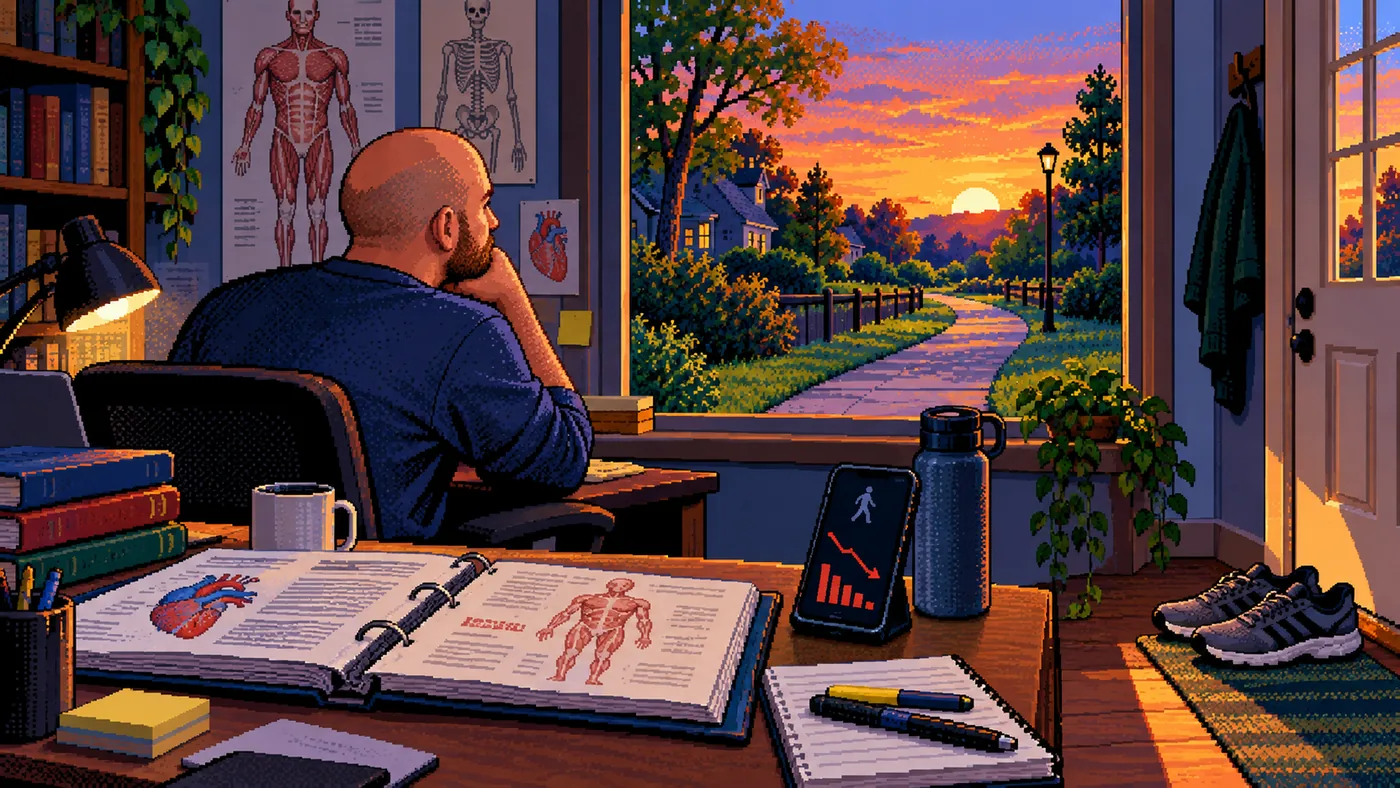
There was a time when walking was part of my daily routine. It gave me space to think, manage stress, and take care of myself. Now, I barely walk at all.
That decline did not happen because I made one dramatic decision to stop caring about my health. It happened through hundreds of smaller decisions that felt reasonable at the time. I needed to finish an assignment. I needed to answer a client. I needed to edit something, study another chapter, handle something for my children, or simply sit still because I was exhausted.
I would walk tomorrow. Eventually, “tomorrow” became the routine.
Health data can be brutally honest because it does not care about intentions. It records the distance between the person who planned to remain active and the person who actually did. My pattern has shifted from consistent movement toward long periods of almost none, and I can feel the difference in my energy, sleep, stress, and ability to tolerate long hours at a desk.
There would be something painfully absurd about studying the human body while continuing to neglect mine. I do not want a new career in healthcare to be built through the deterioration of my own health.
I have not solved that problem yet. Honesty is simply the first step toward solving it.
I Cannot Perform Every Role Perfectly
The hardest lesson may be accepting that I cannot operate at full capacity in every part of my life simultaneously. I cannot be the perfect student, father, client partner, business owner, and perfectly healthy version of myself every day.
Trying to meet all of those standards at once usually means feeling as if I am failing at all of them.
Some assignments will receive more time than others. Some client projects will require late nights. Some personal projects will progress slowly. Some days, being present for my children will matter more than clearing everything from my list. Some days, sleep will have to count as productivity.
For much of my career, productivity became tangled with identity. I proved my value by making things, solving problems, responding quickly, and carrying more than people expected. College has exposed the limits of that approach.
There will always be more work available than one person can responsibly absorb. Maturity may not be the ability to carry everything. It may be the willingness to determine what must be carried now and what can wait.
I Am Not Abandoning the Career I Built
Going back to school does not erase the work that came before it. I am still serving clients. I am still building Malone Media + Marketing. I am still developing Unplugged Tools. I am still considering the future of Upside Down Creative Media and the other projects I have spent years creating.
I still care about media, marketing, production, technology, creativity, and storytelling. Those parts of me are not disappearing.
The difference is that I am no longer demanding that one professional identity carry the entire weight of my future. For a long time, I believed changing direction would mean admitting that the previous direction had failed. I no longer believe that.
A career can be real, successful, and meaningful while still reaching a point when it no longer provides what a person needs. Reinvention does not invalidate the past. It uses the past as material.
Production taught me to prepare. Marketing taught me how people make decisions. Client work taught me to communicate. Technical work taught me to troubleshoot. Parenting taught me that another person’s fear can matter more than my convenience. Being laid off taught me that a job and an identity cannot safely be the same thing.
All of that comes with me into the classroom.
Trying to Be Positive Without Lying
I do not want to turn this into an inspirational success story before the difficult part is over. I have not finished the prerequisites. I have not been admitted to the radiologic technology program. I have not discovered the perfect balance among school, parenting, clients, business, and health.
I am approaching midterms. That is where the story actually is.
I am tired. My routine needs work. My health has declined. My schedule is overloaded, and I do not know exactly what the next few years will demand. But I am learning.
I am proving that my brain can still absorb complex information. I am sitting in classrooms I never expected to enter at this age. I am pursuing a field that may offer a more stable and directly human form of work. Most importantly, I am allowing myself to become a beginner again without pretending that everything I did before was wasted.
That may be the most honest form of positivity available to me. Not insisting that everything is fine. Not pretending determination makes hard things easy. Not declaring victory before reaching the midpoint.
The positive part is that I am still willing to try.
Twenty years after my last college experience, I am back in a classroom with a laptop, phone, binder, and pen. I am learning medical terminology while managing marketing work. I am studying anatomy while trying to repair my own health. I am examining the American Dream while rebuilding my understanding of what a good life might actually look like.
I could have remained frozen, waiting for the job market, a company, a client, or some future version of the economy to decide what my experience was worth. Instead, I enrolled. Now I am moving toward midterms one assignment, one chapter, one deadline, and hopefully one restored walk at a time. I am not starting from the beginning. I am starting from experience.
At nearly 44, I returned to college full time and began completing the prerequisites for FSCJ’s Radiologic Technology program while balancing parenting, client work, business projects, and my health. Last night, I sat in an Anatomy and Physiology classroom with a small laptop, my phone, an open three-ring binder, and more handwritten notes than I have taken in years. A PowerPoint presentation about the muscular system filled the screen while a human skeleton stood nearby, quietly reminding me just how much I am now expected to learn about the structures, relationships, and processes holding a person together. This morning, the notes are still spread across my desk, and I am trying to absorb ...
Start a new thread