
 C:\Content\Personal Essays\The Year I Learned My Anger Was Never About Anger
The Year I Learned My Anger Was Never About Anger
July 7, 2026

For most of my life, I thought I had an anger problem. That’s what everyone saw, including me. They saw the yelling, the raised voice, the defensiveness, the overreactions, the frustration, and the arguments that escalated far beyond where they should have. They heard the words I regretted almost immediately after saying them. They saw a man who looked like he had a short fuse, and for a long time, I accepted that label. “I have anger issues.” It was a simple explanation, but it wasn’t the right one.
This past year has been the hardest year of my life. I lost my marriage, my home, my financial stability, my career, and a version of myself that I genuinely believed was who I would always be. Somewhere in the middle of all of that loss, I started therapy with one goal: figure out why I become the person I become when I’m angry. I expected to spend months learning techniques to control my temper or count to ten before speaking. Instead, I discovered that anger itself was never the real issue. It was simply the emotion everyone could see. It was the messenger, not the message.
The Anger Iceberg Changed Everything
One of the first concepts my therapist introduced me to was something called the Anger Iceberg. It’s a simple but incredibly powerful idea. Anger sits above the surface where everyone can see it, but beneath it are the emotions that actually fuel it: fear, shame, rejection, loneliness, disappointment, grief, insecurity, helplessness, and sadness. Most people react only to the anger because that’s all that’s visible. Very few people stop to wonder what might be underneath.
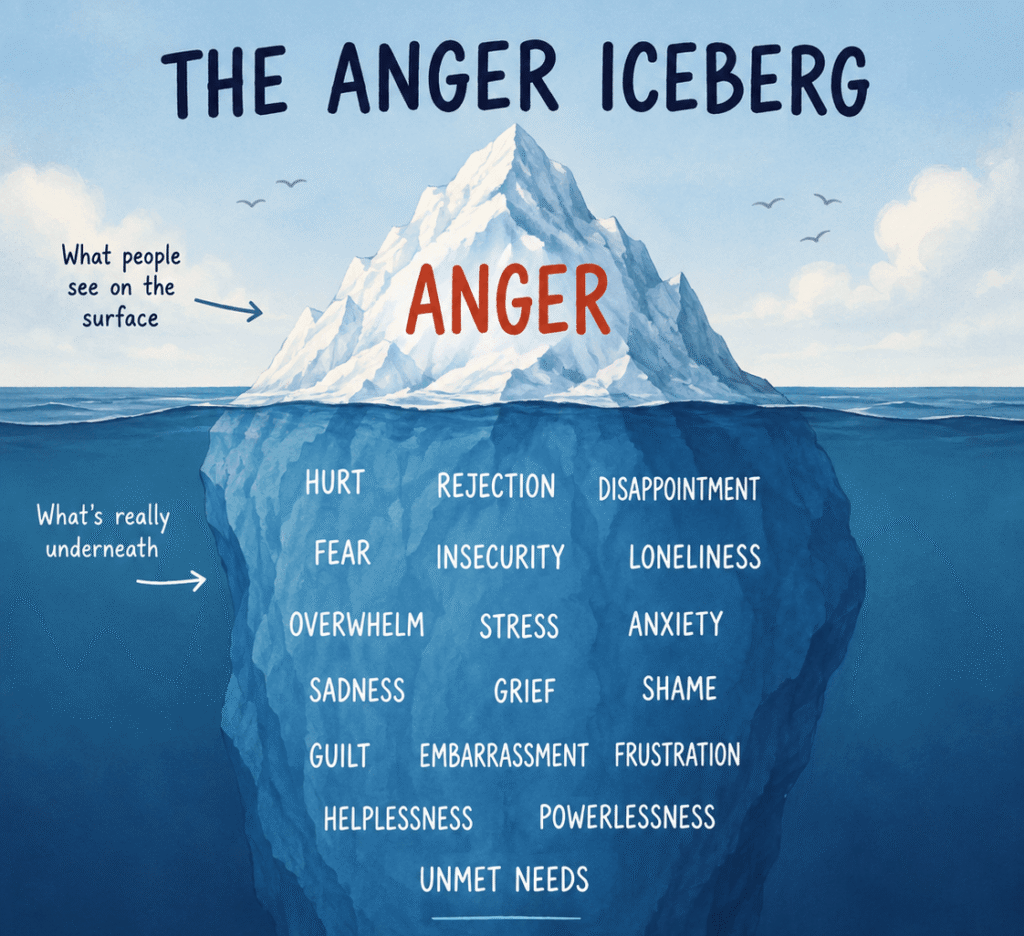
As I began looking beneath my own iceberg, I noticed something that surprised me. One emotion kept showing up over and over again. It wasn’t fear. It wasn’t sadness. It wasn’t rejection. It was feeling misunderstood.
That realization changed everything.
My Real Trigger Was Feeling Misunderstood
Looking back over my life, I can see the pattern almost everywhere. Whenever I felt like someone assumed the worst about my intentions, twisted my words into something I never meant, questioned my character instead of my actions, or refused to hear what I was actually trying to say, something inside me immediately shifted into defense mode. My anger wasn’t trying to hurt people. It was trying to protect me. It was screaming, “That’s not what I meant.” It was desperately trying to say, “Please understand me before you judge me.”
The cruel irony is that anger almost never creates understanding. It usually destroys it. The louder I became, the less people actually heard me. The more I tried to defend myself, the more defensive I sounded. The more defensive I sounded, the more convinced people became that I was simply angry. The harder I fought to be understood, the more misunderstood I became.
What My Anger Actually Looked Like
I’ve also had to be painfully honest with myself about what my anger looked like. I yelled. I screamed. I interrupted people. I became reactive instead of responsive. I overreacted to things that, looking back, didn’t deserve that level of emotion. I said things I didn’t truly mean because I wanted the other person to understand just how deeply I was hurting. Sometimes I wanted them to feel a fraction of the pain I was feeling. None of that represents the man I want to be, and none of it is something I’m proud of.
Understanding where my anger comes from doesn’t excuse the way I’ve behaved. Accountability and understanding have to exist together. I can acknowledge the wound beneath my anger while still taking responsibility for the damage I caused when I let that anger take control.
The Explosion Started Long Before Anyone Saw It
What most people never saw, however, was everything that happened before the explosion. They saw the final five minutes but not the previous five days, five weeks, or sometimes even five months. I rarely exploded out of nowhere. Usually I had already tried explaining myself multiple times. I had tried staying calm. I had tried using different words. I had tried asking questions instead of making accusations. I had tried giving the benefit of the doubt. Every failed attempt added another drop of water into an already full bucket until eventually my nervous system felt overwhelmed. Once I crossed that threshold, it felt almost impossible to stop the reaction that followed.
That doesn’t mean I was powerless. It means I was waiting far too long to deal with what was actually happening beneath the surface.
Stop Protecting the Button. Remove It.
One of the biggest lessons I’ve learned this year is what I now call removing the button. People love saying, “Don’t push my buttons.” The problem is that people are going to push your buttons. Some will do it accidentally. Some will do it intentionally. Some won’t even realize they’re doing it. If my emotional stability depends on everyone else avoiding my buttons, then I’m handing my peace over to other people.
The goal isn’t to protect the button. The goal is to remove it.
For me, that meant asking questions I had never asked before. Why does being misunderstood affect me so deeply? Why do I immediately feel the need to defend myself? Why does someone believing something untrue about me feel like such a threat? Those questions didn’t lead me toward anger. They led me toward old wounds that had been there long before the argument in front of me.
Healing the Wound, Not Just Managing the Anger
I’ve realized that healing isn’t about becoming someone who never gets angry. Anger itself isn’t the enemy. It’s a signal. The work is learning to recognize what it’s trying to tell me before it takes control. Every time I identify the wound underneath instead of simply reacting to the emotion on top, I’m removing another button. Little by little, I’m becoming someone who doesn’t need to convince everyone to understand me because my identity is no longer depends on whether they do.
I don’t know if I’ll ever completely remove every button. But I know this: that’s a much better goal than expecting the world to stop pushing them. People will always have opinions. They’ll misunderstand us. They’ll make assumptions. They’ll say things that hurt. I can’t control any of that. What I can control is whether those things still have access to the deepest parts of me. That’s the work I’m committed to now… not becoming someone who never gets angry, but becoming someone who no longer gives anger the final word.
For most of my life, I thought I had an anger problem. That's what everyone saw, including me. They saw the yelling, the raised voice, the defensiveness, the overreactions, the frustration, and the arguments that escalated far beyond where they should have. They heard the words I regretted almost immediately after saying them. They saw a man who looked like he had a short fuse, and for a long time, I accepted that label. "I have anger issues." It was a simple explanation, but it wasn't the right one. This past year has been the hardest year of my life. I lost my marriage, my home, my financial stability, my career, and a version of myself that I genuinely believed was who I would always be. ...
Start a new thread