
 C:\Content\Personal Essays\Why Can’t I Get a Job Right Now? AI, Outsourcing, and the Labor Market
Why Can’t I Get a Job Right Now? AI, Outsourcing, and the Labor Market
September 2, 2026

A skilled American professional confronts a labor market transformed by artificial intelligence, automation, and borderless hiring... where experience alone no longer guarantees employment.The official unemployment rate misses millions of Americans who want more work or better-paying work. Remote hiring has expanded the candidate pool across borders. AI is making competent marketing cheaper and more common. So why are experienced workers being told that naming these realities is “too negative”? Why are so many people asking “why can’t I get a job right now?“
Late last year, a digital marketing agency gave me reason to believe full-time work might finally be coming. I had already worked with the company. I knew the business, the clients, and the expectations, but the position went to a previous employee because, I was told, bringing that person back would make onboarding easier. That explanation hurt, but it at least resembled a business decision: familiarity reduces risk. I accepted it. Then that employee left a few months later and my phone suddenly lit up. For roughly a week, the messages were urgent. There was talk of work and employment. The need sounded immediate, and I responded as someone ready to contribute… not as someone asking for charity. Then the urgency vanished. Communication faded. Later, LinkedIn showed me what the company had not bothered to explain directly: the agency had hired two people based in Argentina. The modern rejection letter, apparently, is no letter at all. It is discovering through an algorithm that the people who urgently needed you found a more convenient arrangement and decided your dignity did not require a reply.
I cannot prove why those particular workers were chosen. I do not know their salaries or what decision-makers said behind closed doors, and those employees may be excellent at their jobs. They did nothing wrong by accepting an opportunity. But refusing to invent a motive does not require me to become economically illiterate. Geography, labor cost, and remote work plainly shape the modern hiring market. Nearshore staffing companies openly sell American businesses on lower costs; Deloitte describes domestic cost pressure as one reason U.S. companies look internationally and identifies Latin America’s skilled workforce, proximity, compatible time zones, and operating cost as advantages. The sales pitch is not hidden. It is the business model. American professionals are told that the labor market is healthy while American employers are handed software that lets them shop for labor in economies with radically different wage floors. Calling that observation “negative” does not make it false. It merely protects the people benefiting from the arrangement from having to discuss it.
Around the same time, I was told that my LinkedIn presence could be a problem… that I seemed too negative and too “anti-AI.” The accusation was almost surreal. I was posting about artificial intelligence years before generative AI became a mandatory bullet point in every marketer’s bio. I use AI, build with it, and study how it changes search, content, production, and consumer behavior. My argument was never that artificial intelligence should disappear. My argument was that fear is being used as a sales tactic, companies are overstating short-term certainty, and AI will eventually flatten many of the optimization advantages agencies currently sell. When everyone has capable writing, analysis, keyword research, image generation, automation, and testing, producing more optimized material will stop being much of a moat. Brand will matter more. Trust will matter more. Reputation will matter more. The way a company treats people when it has leverage will matter more. Apparently, saying that out loud makes me negative. I think it makes me early… and I suspect “anti-AI” was simply a more respectable phrase than “this applicant has publicly noticed how the business model works.”
The unemployment rate and the unemployment experience are different things
In July 2026, the official U.S. unemployment rate was 4.1%. Read casually, that sounds healthy. It suggests that almost everyone who wants a job has one and that an experienced applicant who remains unemployed must be doing something wrong.
The rest of the government’s own report complicates that comforting story. The Bureau of Labor Statistics counted 6.9 million people as officially unemployed. It also reported 4.8 million people working part time for economic reasons… people who wanted full-time work but could not get it or whose hours had been reduced. Another 5.9 million people outside the labor force said they wanted a job but were not counted as unemployed because they had not actively searched during the previous four weeks or were not immediately available. Long-term unemployment stood at 1.8 million, representing 25.5% of all unemployed people.
Those categories overlap in places and should not simply be added together. But they reveal something the single headline rate conceals: “not unemployed” is not the same as securely, adequately, or fully employed.
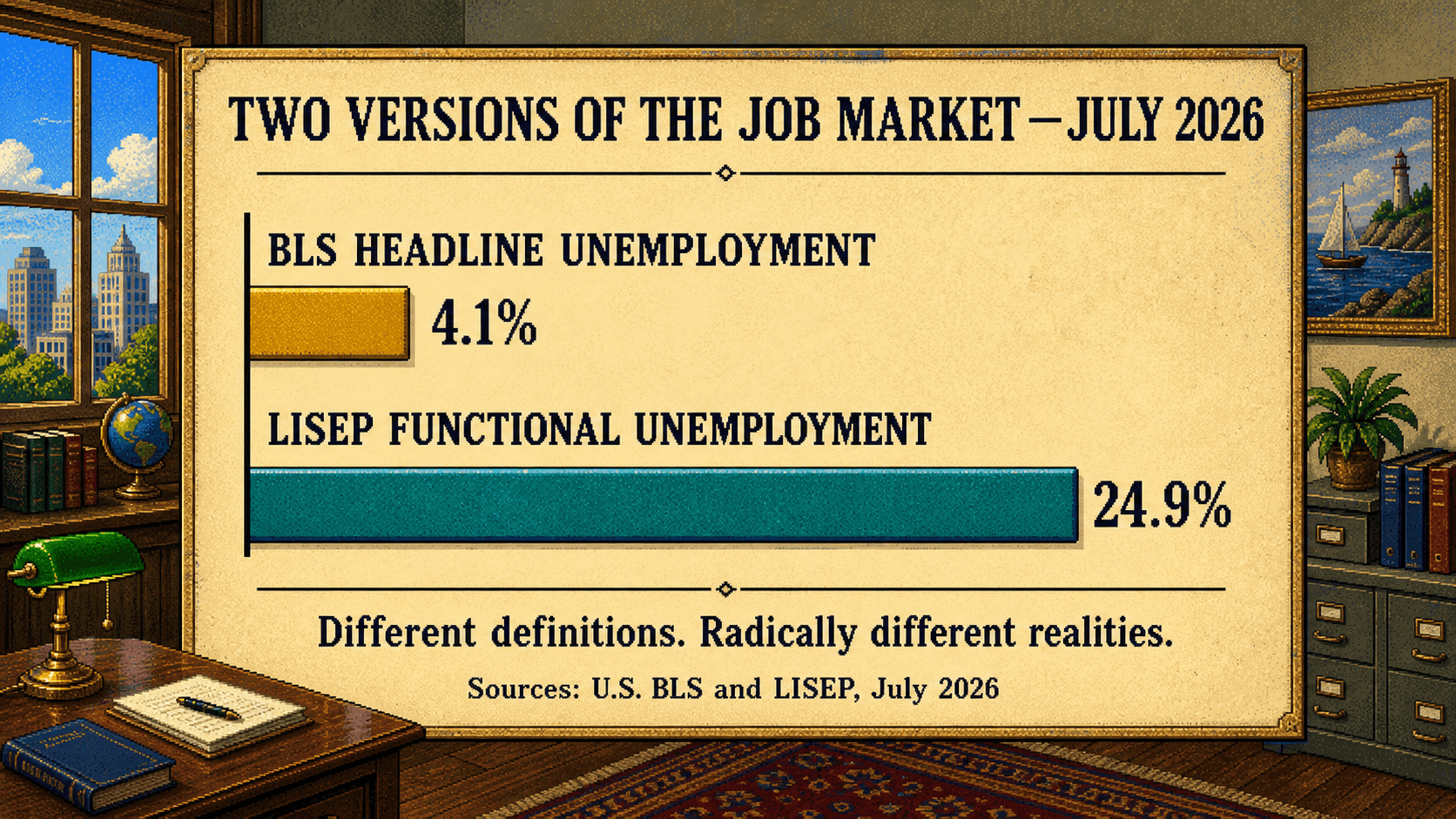
Comparison showing July 2026 BLS headline unemployment at 4.1% and LISEP functional unemployment at 24.9%The Ludwig Institute for Shared Economic Prosperity, or LISEP, tries to measure that difference. Its True Rate of Unemployment, called TRU, counts people as functionally unemployed when they want full-time work but do not have it, have no job, or earn below a basic living-wage threshold. LISEP says that threshold is conservatively set at $26,000 annually in 2025 dollars before taxes.
For July 2026, LISEP’s measure was 24.9%… more than six times the official 4.1% rate.
LISEP’s number is not a replacement for BLS unemployment. It answers a different question. BLS asks whether someone meets a precise definition of unemployment: no job, available for work, and actively searching recently. LISEP asks whether people who want full-time, living-wage work actually have it.
Both questions are legitimate. Only one resembles what millions of households experience.
If someone edits videos for ten hours this week, drives for an app next week, sells a freelance project the week after that, and still cannot reliably cover rent and health care, an economist may place that person outside the unemployment column. The person still experiences economic instability. The landlord does not accept a labor-force classification in place of payment.
This gap matters because it shapes how we judge job seekers. A low headline rate encourages a moral story: jobs are abundant, therefore anyone without one must lack skills, effort, adaptability, or the right attitude. A broader measure suggests another possibility: the labor market can produce plenty of activity without producing enough stable, adequate employment.
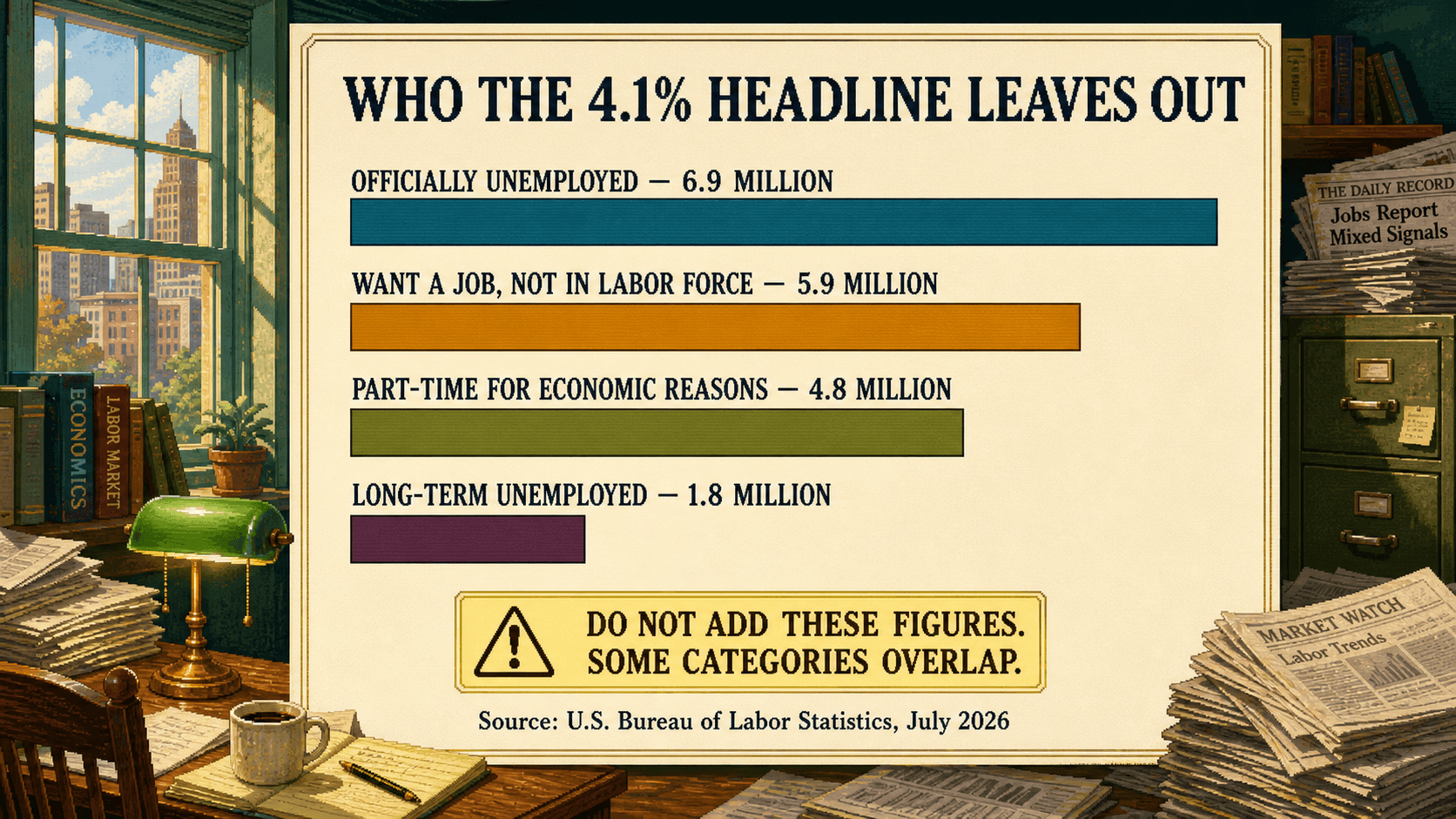
The headline rate excludes or obscures several forms of labor-market hardship. Categories may overlap and should not be added together. Source: U.S. Bureau of Labor Statistics.The Federal Reserve’s 2026 report on household economic well-being provides another warning. Looking back at 2025, it found that 8% of prime-age adults said they were not working because they could not find work. Among adults under 30, 15% were not working because they could not find a job and another 10% were working part time because they could not find more work. One in four young adults therefore reported one of those two forms of difficulty. At the same time, one in four workers said they had used generative AI for work in the previous month.
That is the actual transition: AI adoption rising inside a labor market that looks stronger in the headline than it feels to many participants.
American applicants no longer compete only with American applicants
Remote work changed more than commuting. It changed the geographic boundary of a job opening.
Before remote infrastructure became normal, a Jacksonville agency hiring a marketer generally searched Jacksonville, nearby cities, or people willing to relocate. Now the same agency can recruit in Florida, across the United States, or across much of the Western Hemisphere. Collaboration platforms, international payroll services, employer-of-record companies, and contractor marketplaces make the operational friction much smaller than it used to be.
The result is an expanded effective labor pool. An American worker applying for a remote marketing, design, editing, development, analytics, or customer-support role may not be competing with 100 local applicants. They may be competing with hundreds or thousands of qualified people living in countries where the prevailing wage is lower.
This is not a conspiracy theory. It is advertised as a service.
Deloitte has written that U.S. companies face domestic cost pressures and limited talent supply and are increasingly considering Latin America for nearshore software and digital work. It notes that major international employers have established operations in Mexico, Colombia, Costa Rica, and Brazil. Deloitte also points to same-time-zone collaboration and a growing skilled workforce as genuine advantages… not merely cheap labor.
The International Labour Organization surveyed 1,153 web-platform workers across 21 Latin American and Caribbean countries. Its 2025 report found that 53% worked for recruiters outside the region. These were not an unskilled population: 38% held bachelor’s degrees. The ILO also found precarity on their side of the transaction. More than half used platform work as secondary income, while exclusive platform workers faced income near minimum-wage levels and gaps in social protection.
That is why blaming Latin American workers would be both cruel and analytically lazy. They are responding to the same economic system I am. They want stability. They have skills. They accept opportunities offered to them. The power to define the job, select the employment arrangement, set the compensation, and communicate honestly rests with the employer.
The uncomfortable point is not that an Argentine worker “took” an American job. The point is that remote work lets an American company compare labor across radically different wage environments while American workers still pay American rent, American insurance premiums, American tuition, and American medical bills.
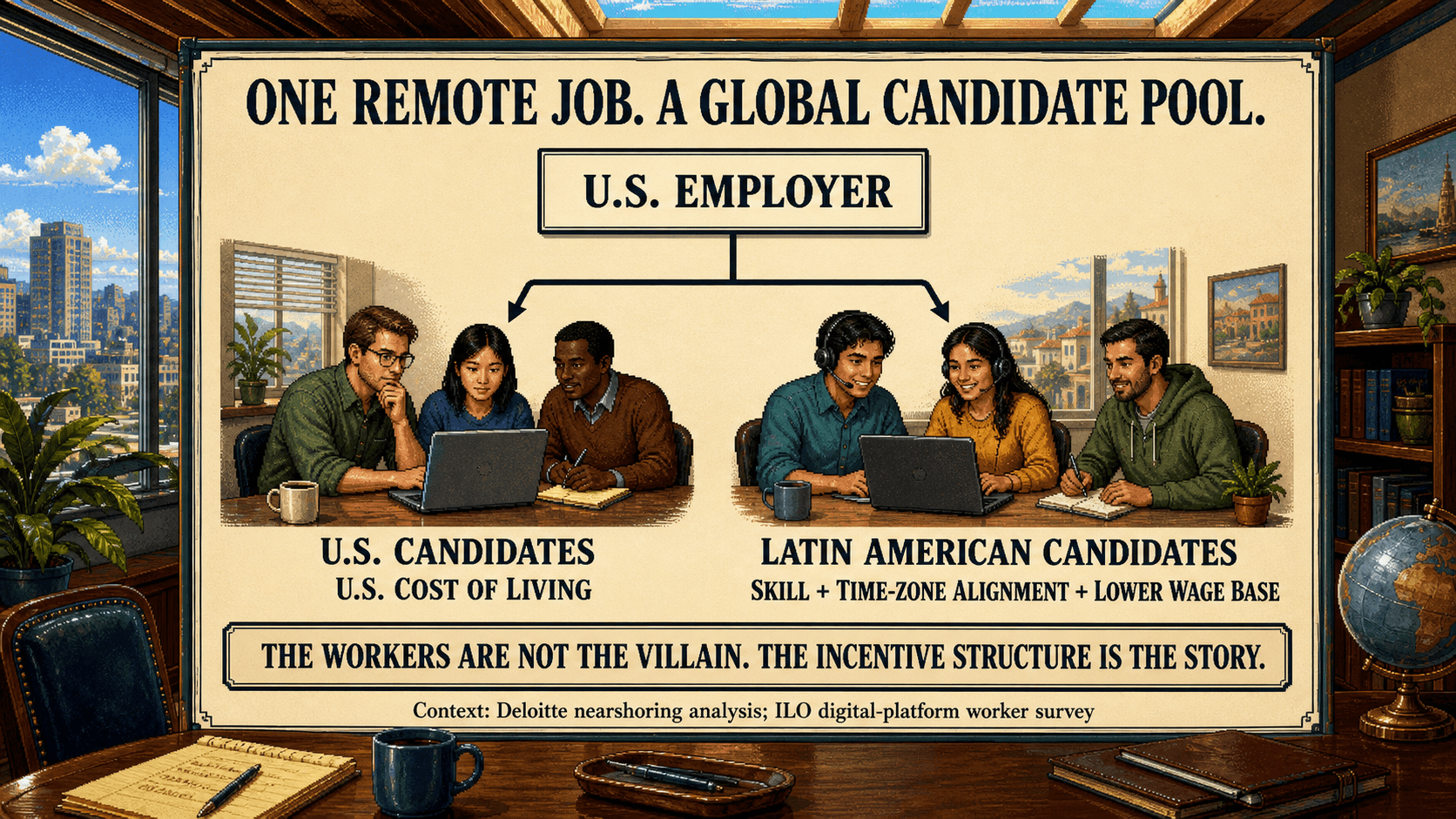
Remote hiring gives American employers access to a global candidate pool shaped by skills, time-zone alignment, wages, and differing costs of living. The workers are not the villain; the incentive structure is the story.When nearshore recruiting firms advertise 40% to 60% savings against U.S. rates, that number should be treated as a vendor claim, not a neutral government statistic. Yet the language reveals the incentive being sold. If two candidates can perform similar work and one costs half as much, experience alone may not protect the higher-cost candidate. Neither will loyalty, previous familiarity, or the fact that the employer briefly made the opportunity sound imminent.
The common response is that Americans must “upskill.” That advice is not useless, but it is incomplete. If a candidate learns a new platform, candidates everywhere can learn it. If a writer adopts AI, writers everywhere can adopt it. If an editor automates transcripts, rough cuts, captions, and social clips, editors everywhere can use the same tools. The technology that increases one worker’s productivity also makes it easier for employers to distribute work globally.
Skill remains necessary. It is no longer sufficient.
AI is not only replacing tasks; it is changing what companies value
Much of the AI conversation is trapped between two cartoons. In one, AI is magic and anyone raising a concern is a frightened Luddite. In the other, AI is a fraud and every existing job will continue unchanged. Reality is less convenient.
AI can be genuinely useful while destabilizing employment. It can make a talented person more productive while allowing a company to need fewer people. It can create new categories of work while lowering the price of work that used to require specialized knowledge. It can improve quality in some contexts and flood the market with undifferentiated sludge in others.
The Federal Reserve found that 81% of workers who used generative AI said it saved time, while 52% said it improved quality and 55% said it enabled new tasks. Those benefits are real. But productivity gains do not automatically become worker security. The person doing twice as much work does not automatically receive twice the pay. Sometimes the organization simply decides that one person can now do what two people did before.
Marketing is especially exposed because so much of the industry sells repeatable outputs: blog posts, keyword plans, ad variants, captions, email sequences, landing pages, reports, thumbnails, and basic video versions. AI can already accelerate all of them. As models and interfaces become cheaper and more capable, the baseline quality of those outputs will rise.
That is why I have argued that optimization itself will flatten.
When every agency can generate 100 headline options, headline generation is not the competitive advantage. When every site can produce schema, FAQs, topical clusters, summaries, and metadata, merely having those assets is not the advantage. When every company can imitate a tone, generate a stock-style image, and publish on a schedule, volume is not the advantage.
The scarce asset becomes believability.
Do customers trust the company? Do employees and contractors describe it as honest? Does its public behavior match its stated values? Does it communicate directly when plans change? Does it treat people as relationships or disposable capacity?
AI can generate a company’s employer-brand copy. It cannot retroactively make the company behave well.
“Too negative” often means “too difficult to dismiss”
LinkedIn has developed a peculiar emotional dress code. Job seekers are expected to be authentic, but never angry. Vulnerable, but not unsettling. Thoughtful, but not too critical of the systems deciding whether they can pay their bills. We are encouraged to tell our stories as long as every hardship becomes a clean lesson and every rejection ends with gratitude.
The acceptable unemployed person is relentlessly optimistic. He announces that he is “open to work,” praises every interviewer, treats ghosting as a networking opportunity, and converts desperation into inspirational content. He does not ask whether the job was real. He does not ask whether the employer moved it overseas. He does not mention that months without work erode savings, confidence, health, and family stability.
If he does, he risks being called negative.
That label is powerful because it converts a structural criticism into a personality defect. Instead of answering the claim, people assess the claimant’s attitude. Instead of discussing labor arbitrage, underemployment, or the consequences of automation, they ask whether the speaker is “a culture fit.”
Calling me anti-AI performs the same trick. It avoids engaging with what I actually said: AI-generated optimization will become common, and when it does, corporate reputation will carry more weight. A company that uses fear to sell AI services while dismissing legitimate fears about jobs is not demonstrating technological sophistication. It is marketing certainty it does not possess.
I do not hate AI. I hate dishonest narratives about power.
I hate being told that workers must adapt endlessly while companies owe no transparency in return. I hate the idea that an employer can create urgency, disappear, hire elsewhere, and still expect anyone describing the experience to protect its brand more carefully than the company protected the person.
Experience can become a liability when employers optimize for cheap and easy
I have spent more than two decades creating digital content and more than thirteen years working across marketing. I have held management, SEO, broadcast-production, content, video, podcast, photography, web, social, email, e-commerce, and analytics responsibilities. I have built things before there was a fashionable job title for building them. I learned AI early enough to criticize it from experience instead of fear.
On paper, range should make me valuable. In practice, range can confuse hiring systems designed around narrow titles. A recruiter searching for an SEO specialist may see video production as irrelevant. A production employer may see marketing leadership as evidence that I will leave. A junior role may consider me overqualified. A senior role may demand a perfectly linear history. Entrepreneurship may be read as initiative or as inability to take direction, depending on the viewer.
Experience also has a price attached to it. Employers may assume an experienced American candidate expects higher compensation, better communication, clearer boundaries, and a path forward. A less expensive remote hire, a former employee who can be onboarded quickly, or a younger candidate whose résumé mirrors the job description may look easier.
Hiring technology intensifies the problem. Applicant-tracking systems reward exact language. Automated assessments reduce people to scores. AI-generated applications increase volume, which encourages employers to use more automation to filter them, which encourages candidates to use more AI to pass the filters. Both sides escalate. The signal gets weaker. The process gets less human.
Then employers complain that candidates lack authenticity.
Why can’t I get a job even with experience?
That question is the part of this experience that makes the least sense on paper. I am not trying to enter the workforce for the first time. I have more than a decade in digital marketing and more than two decades creating digital content. I have managed campaigns, built websites, produced television and video, directed shoots, edited podcasts, worked in SEO, handled analytics, and adapted repeatedly as platforms changed. Yet experience does not automatically make a candidate easier to hire. In a market optimized for lower cost, speed, and minimal onboarding, experience can be interpreted as expense, independence, or a threat to a rigid job description. Employers say they want someone who can do everything, but a person who has actually done everything may look harder to fit into a narrow salary band.

So when an experienced or qualified worker asks, “Why can’t I get a job with my degree or experience?” the answer is not necessarily a missing credential. The mismatch may be between what the applicant can contribute and what the employer is currently rewarding. A company may prefer a familiar former employee, a less expensive remote worker, an internal candidate, or someone whose résumé mirrors the posting more literally. None of those outcomes proves the rejected applicant lacks value. It shows that hiring is not a neutral ranking of talent. It is a business decision shaped by cost, perceived risk, convenience, timing, and power.
Why can’t I get a job interview or offer?
Not getting an interview is especially disorienting because there is usually no useful feedback. A rejection email rarely says whether the role was filled internally, paused, rewritten, flooded with applicants, or given to someone referred by an employee. The applicant sees only the result: another application disappeared. That silence encourages people to treat every rejection as a verdict on their résumé, even when the decision may have been made by circumstances they could never see or influence.
Job seekers still have to improve what they can control. The résumé should make the target role obvious, lead with relevant results, use the language employers actually use, and show proof of work. But optimization has limits. A stronger résumé can improve the odds of being understood; it cannot force a company to value the candidate, disclose its real hiring priorities, or choose an American applicant over a cheaper international arrangement. The refusal to acknowledge those limits has turned job-search advice into a strange ritual in which unemployed people are told to keep rewriting themselves until the market agrees they deserve to participate.
Why can’t I get a job through Indeed?
Indeed, LinkedIn, and other job boards can distribute an application, but they do not create a relationship or guarantee that a visible listing represents an urgent, attainable opening. Applying through a platform also places the candidate inside the largest possible pool. That does not make the platforms useless; it means they should be treated as discovery tools rather than proof that “everyone is hiring.” Direct outreach, referrals, portfolio evidence, and conversations with actual decision-makers may create context that a standardized application cannot. Even then, there is no magic channel that removes cost pressure, global competition, or employer indecision.
If everyone is hiring, why can’t I get a job?
Because “jobs exist” and “employers are offering stable, adequately paid work to people with my background” are not the same statement. The headline unemployment rate can be low while millions of people remain underemployed, outside the official count, stuck in part-time work, or unable to convert applications into offers. A company can advertise a position while remaining highly selective about salary, geography, experience, personality, and perceived risk. It can also search far beyond the local labor market. The existence of an opening therefore says very little about whether a particular worker has a realistic path to it.
That is why people keep searching “why can’t I get a job right now?” The question is personal, but the answer is not purely personal. AI is compressing tasks, remote infrastructure is expanding the labor pool, and companies can compare workers across radically different economies. At the same time, applicants are expected to remain endlessly upbeat so that describing the market does not make them look difficult. I can keep improving my materials and expanding my skills, but pretending those structural forces do not exist would not make me more employable. It would only make me quieter.
What I am asking for is not protection from competition
I am not asking American employers to reject international talent. I am not asking for a guaranteed job because I have worked hard. I am not asking anyone to pretend AI is harmless or to freeze technology in place.
I am asking for an honest description of the market.
Say that a remote American job may now be a global competition. Say that salary arbitrage is part of the calculation when it is. Say that official unemployment excludes many people who want more work or better work. Say that “upskilling” cannot solve a mathematical problem in which every candidate is told to become exceptional while the number of stable roles contracts or moves. Say that AI productivity can enrich companies without improving the security of the people producing that value.
Most of all, stop demanding emotional obedience from unemployed people.
If my analysis is wrong, challenge the evidence. If my prediction about AI flattening optimization is wrong, show me why. If my public posts misstate a fact, correct it. But “too negative” is not a rebuttal. It is a warning that employability now includes performing optimism for the people with the power to exclude you.
The irony is brutal. Companies say they want critical thinkers, strategic foresight, authenticity, strong communication, comfort with AI, multidisciplinary experience, and the courage to challenge assumptions. I have built a career around those qualities. Yet when I apply them to the labor market itself, they become risks.
I can direct a shoot, edit a campaign, build a website, optimize a page, produce a podcast, analyze performance, manage content, learn new systems, use AI, question AI, and explain where I believe the market is going. I can point to years of work rather than theoretical potential.
The official data says unemployment is low. The broader data says nearly one quarter of the labor force is functionally unemployed. Employers say talent is scarce while technology allows them to search the planet. LinkedIn says to build a personal brand, then punishes people whose personal brand includes an uncomfortable truth.
I have adapted. I have learned. I have produced. I have led. I have accepted contract work, changed industries, returned to school, expanded my skills, and continued creating while rejection after rejection asked me to treat uncertainty as a motivational exercise.
So I am done ending this conversation with a polished lesson about resilience. I have a more honest question:
WHY CAN’T I GET A JOB RIGHT NOW?
References
- U.S. Bureau of Labor Statistics, The Employment Situation—July 2026
- Ludwig Institute for Shared Economic Prosperity, True Rate of Unemployment
- Federal Reserve, Report on the Economic Well-Being of U.S. Households in 2025
- International Labour Organization, Survey on Workers on Web-Based Digital Platforms
- Deloitte, Software Engineering Nearshoring: The Case for Latin America
A skilled American professional confronts a labor market transformed by artificial intelligence, automation, and borderless hiring... where experience alone no longer guarantees employment. The official unemployment rate misses millions of Americans who want more work or better-paying work. Remote hiring has expanded the candidate pool across borders. AI is making competent marketing cheaper and more common. So why are experienced workers being told that naming these realities is “too negative”? Why are so many people asking "why can't I get a job right now?" Late last year, a digital marketing agency gave me reason to believe full-time work might finally be coming. I had already worked with...
Start a new thread